
The Year Without a Summer - Shifting climate
Volcanoes, Ships, and Lockdowns Go Rogue

This is entirely a stream-of-consciousness article, short form, and although hopefully informative, self-indulgent because it amuses me. 3 years ago I wrote an article about a rather peculiar set of events that caught my attention for years, my writing style was yet to be honed, and how I presented information obviously changed but the article’s significance remains.

In this article, I argued the following.
I am not arguing that the Tonga eruption will replicate the YWAS, my argument is, that these volcanos spewing Sulfur Dioxide, La Palma for months, other volcanos for weeks, and Tonga all at once will add to the fire of massive shifts in weather patterns. I also said, back in the La Palma days, that this was a trend, of volcanic explosions affecting and shifting climate faster than man can. The first lockdown already cemented the trend. Back then I wasn’t aware of YWAS.
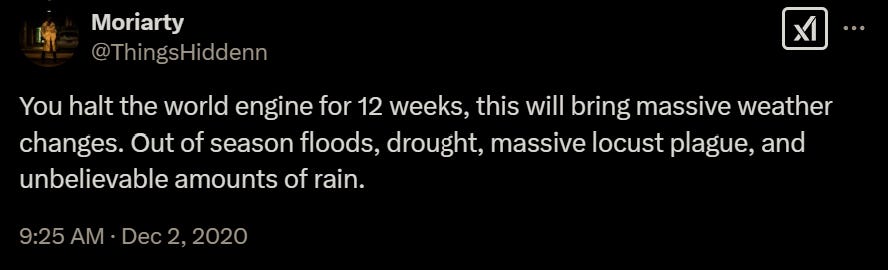
My poorly presented argument at the time was never that the continuous eruptions would replicate The Year Without Summer, but that especially La Palma and Tonga’s eruptions were going to impact the climate more than scientists were comfortable stating, given how large the Green industry is, and how much grant money is shoveled in.
The Year Without a Summer is a rather peculiar and highly interesting historical event to delve into, especially given its non-linear effects, such as inspiring Mary Shelley to write Frankenstein, Byron to write Darkness, and Polidory to write Vampyre. A lasting beautiful poem and two of the books that had everlasting impact on culture itself. My argument at the time was, and still remains to this day, that these events would contribute to a massive, drastic global weather shift.
First, we need Chrono’s help to rewind time and go back to 2020. As much and well-deserved bad reputation pollution gets, over the decades our beautiful planet as one of the most complex self-adaptable systems in the universe, acclimated to the presence of specific microparticles in our atmosphere. Climate change is a cult, but the contribution of pollution to weather patterns is real, it isn’t just catastrophic, just the world being the world.
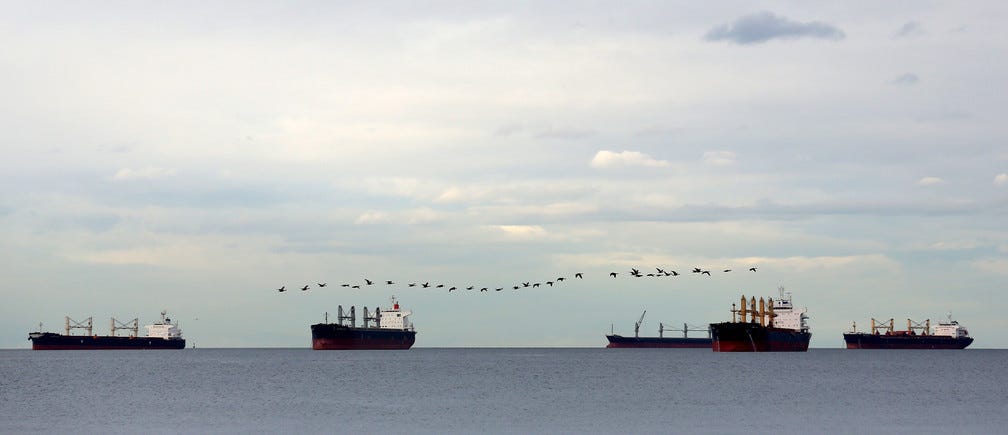
The International Maritime Organization following the doom cult that is the “green politics” implemented a new regulation right before the pandemic, demanding ships to use cleaner fuel, mostly aimed at limiting sulfur emission. Sulfur particles play a role in global atmospheric changes, by reflecting sunlight (thus cooling the planet), and changing cloud formation, and nothing emits as much sulfur dioxide as volcanoes.
Stopping the emission in a abrupt manner, and using “cleaner” fuel would have a lasting impact on the global weather, causing drastic shifts in its well-studied and tracked patterns. Thus, slowly but surely the evidence catches up to us, who pay attention to the hidden patterns.
Radiative forcing from the 2020 shipping fuel regulation is large but hard to detect
Reduction in aerosol cooling unmasks greenhouse gas warming, exacerbating the rate of future warming. The strict sulfur regulation on shipping fuel implemented in 2020 (IMO2020) presents an opportunity to assess the potential impacts of such emission regulations and the detectability of deliberate aerosol perturbations for climate intervention. Here we employ machine learning to capture cloud natural variability and estimate a radiative forcing of +0.074 ±0.005 W m−2 related to IMO2020 associated with changes in shortwave cloud radiative effect over three low-cloud regions where shipping routes prevail. We find low detectability of the cloud radiative effect of this event, attributed to strong natural variability in cloud albedo and cloud cover. Regionally, detectability is higher for the southeastern Atlantic stratocumulus deck. These results raise concerns that future reductions in aerosol emissions will accelerate warming and that proposed deliberate aerosol perturbations such as marine cloud brightening will need to be substantial in order to overcome the low detectability.
The regulations proposed by the IMO in 2020 reducing sulfur from 3.5% to 0.5% led to an 80% drop in sulfate aerosol emissions. Using Machine Learning techniques, the authors attempted to quantify these changes and how they affected natural cloud variability.
The regulation caused a global radiative forcing of +0.074 ± 0.005 W m⁻² due to reduced cloud brightening (fewer sulfate aerosols meant fewer cloud condensation nuclei, leading to larger cloud droplets and less sunlight reflection), in simple terms the IMO 2020 regulation quite literally, inadvertently reshaped Earth’s energy balance. So my early observations are still relevant.
While outside the scope of the author’s intricated analysis, it stands to reason that the lockdowns accelerate an already pernicious hidden trend, cleaner fuel contributing to warming, rather than aiding in cooling. The most likely outcome is this initiated a global, ecosystem-wide cascade of events leading to each part of our complicated living system to adapt, a true textbook case of a non-linear dynamics cascade.
So if merely changing the ship’s fuel and stopping the entire maritime traffic affected the global climate, how well does my Tonga assertion ?
Long-Term Temperature Impacts of the Hunga Volcanic Eruption in the Stratosphere and Above
Key Points
Global average cooling of 1–2 K is observed in the upper atmosphere during 2022–2024 following Hunga eruption in January 2022
Good agreement of observations with chemistry-climate model simulations; cooling is mainly due to Hunga H2O impacts
Hunga-forced cooling is comparable in magnitude to stratospheric warming following El Chichón (1982) and Pinatubo (1991) eruptions
We analyze temperature changes in the upper atmosphere due to the Hunga volcanic eruption in January 2022 using satellite observations and simulations from a state-of-the-art chemistry-climate model. Hunga was an underwater volcano that emitted a large amount of water vapor (H2O) directly into the stratosphere, and this H2O has moved slowly upwards over time and mostly remains in the upper atmosphere. Observations show cooling of the stratosphere (20–50 km) by 0.5–1.0 K during 2022 to middle 2023, and cooling of the mesosphere (50–80 km) by 1.0–2.0 K after middle 2023. The cooling patterns follow the upward moving Hunga H2O plume. The model simulations show good agreement with observations, and the model is used to diagnose that the cooling is due to Hunga H2O impacts. The long-lasting, global-scale cooling from Hunga has similar magnitude, but opposite sign, to stratospheric warming observed from previous large volcanic eruptions (El Chichón in 1982 and Pinatubo in 1991); the differences are due to the large H2O emitted by Hunga.
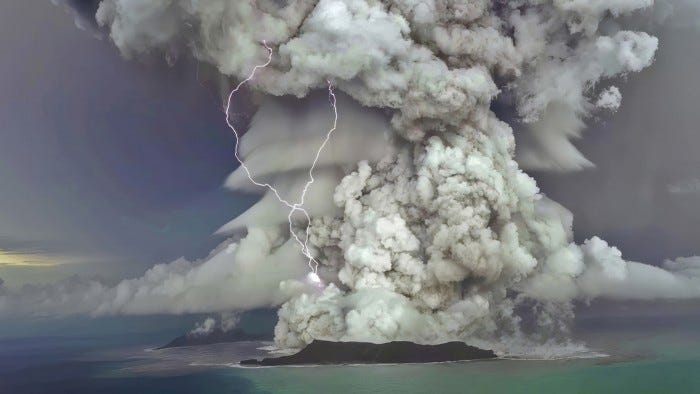
While the media loves to spout the “once in a century” event for large, and massive disasters, especially present in the last few years the leviathanic eruption of the submarine volcano Tonga was, truly, a once-in-a-century event. Its eruption was so explosive, that it created visible gravitational waves, these waves are in a literal sense, ripples in space and time, changing gravitational fields themselves, affecting the fabric of reality itself.
It gave scientists and physicists enough data to send some into sheer “jumping because I am so happy”. And now, in simpler words, we have evidence of the climatic effects of said eruption. The Tonga eruption was unique because it wasn’t sulfuric particles and ash injected into the atmosphere, but an absurd amount of water vapor directly into the stratosphere.
The effects of the Tonga eruption will probably reverberate and cascade throughout the decade, affecting and shifting the global weather in complex ways. I have the highly speculative proposition that these events were accelerated or “incentivized” by the 2020 lockdowns, a rather “schizo” take and exceedingly if not borderline impossible to prove, but still fun to think about and consider it.
May your week ahead be filled with joy and happiness. And as always, thank you for supporting my work.

We had some impressive rain events this fall, described as "Atmospheric Rivers" by the Weather Network, the occurrences no doubt a result of the "Climate Catastrophe"(TM). Formerly the rainstorms were referred to as the "Pineapple Express" due to their presumed origin near Hawaii. January was unusually dry and we have our annual snow this week.
I asked a friend's AI about the annual planetary rainfall to attempt to find when the excess water from Hunga Tonga would fall to earth. The advice was to consult some technical reference as the machine was not able to develop an answer.
I appreciate your review and information that the vaporised water will circulate in the stratosphere until it cools the planet and we have the alternate climate catastrophe.
In terms of the sulphur lost from cargo ships we would need to know the dimension of tonnes of bunker fuel used and cleansed compared to the annual use of thermal coal on a planetary basis. Without looking I would think that the new build coal-burning electricity plants in China and India would overwhelm the changes from the cleansing of the marine fuels.
Moriarty, I would think this article would go into your Beyond Mathematical Odds substack, and I now recall that we haven't had any articles on that Substack since almost a year ago. Have you decided to consolidate everything into this Substack after all?
This article is quite interesting, as I had no real idea that event-level analysis could be this granular. I've often shaken my head at people on the one hand screaming about global warming, including all the massive investment to keep it from happening, and then they turn around and go after all the sources of sulphur dioxide which easily and effectively cool the planet. Yet more baloney from these folks.