
Decreased lung function 2 years after mild Covid
With a few caveats !

As I intended, a mid-week article, directly to the point of things I wanted to discuss. I will also be using this to just broadly address the numerous questions I kept receiving the past 10 days, which fits the theme of the second paper we will discuss. But first, a fun one, kinda.

A long time ago, a concerning study was published where the authors found that the mRNA vaccines impact sperm quality, and motility (the movement capacity which is very important if you want to have kids at the time) for up to 150 days. At the time I laughed at the “prognosis is good” because, how would we know without long-term data ?
I did say after, multiple times, that I did expect the virus to do the same, and both being recoverable for the most part.
Does COVID-19 affect sperm quality in males? the answer may be yes, but only temporarily
This was a study done in China, in the Guilin Hospital, while there is no reference in the paper at least that I could find for the vaccination status of the males in the patient group here, the likelihood is they were vaccinated with the Chinese vaccine which has a better “safety” profile among the vaccines.
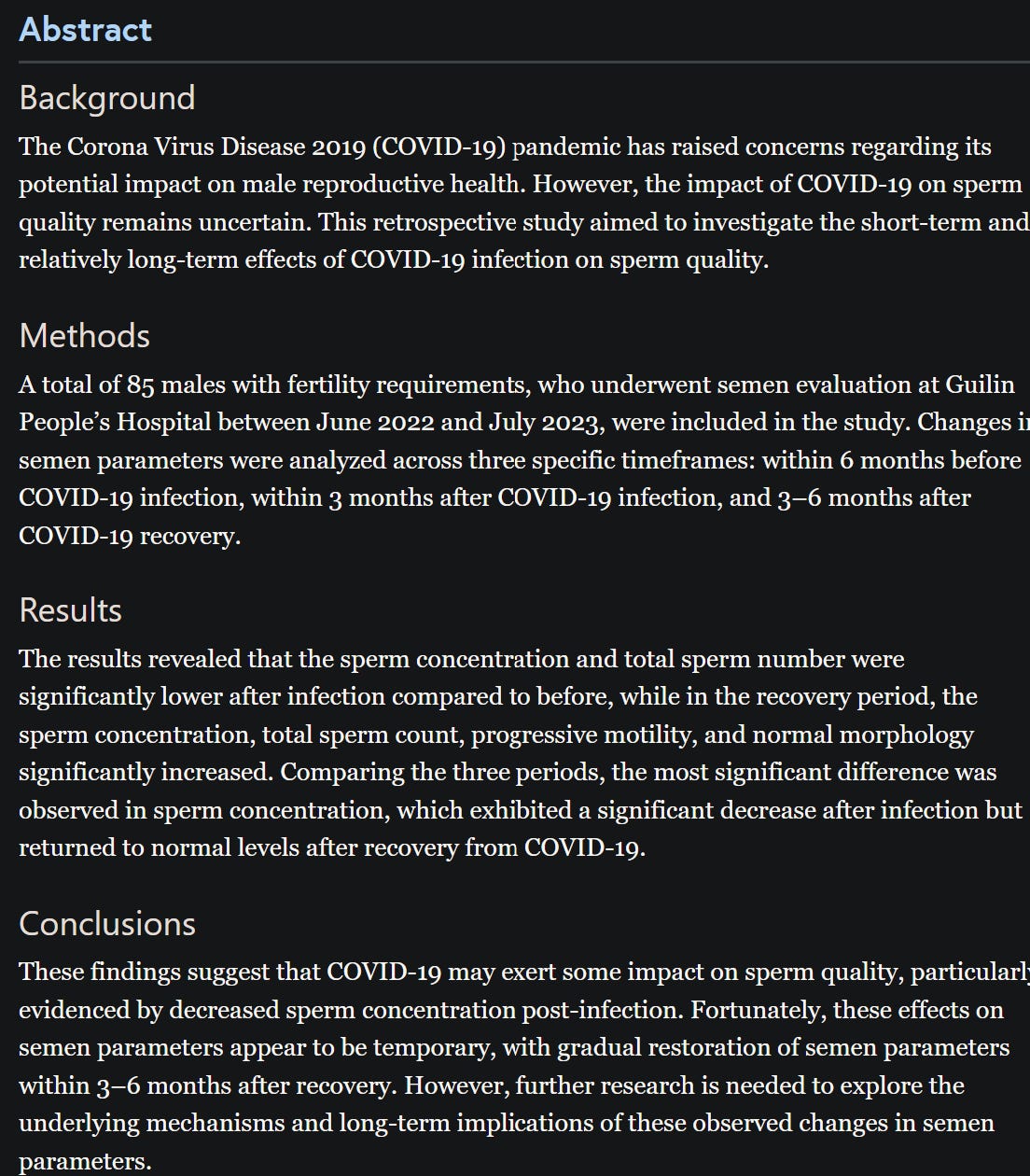
The good news, for the most part excluding outliers, recovery from decreased sperm quality after Covid infection is recoverable after a few months, as one would expect. The bad news from my perspective is my suspicion that the virus and the mRNA-derived Spike Protein share similar mechanisms initially and at the end-point for the decrease in sperm quality and motility.
Unless experiencing severe metabolic or some sort of endocrine (hormonal) issue, I expect the vaccinated to recover but it will take far longer than others and they will need a helping hand (supplementation). With a small, little caveat. If what I will propose in my next article happens, they will have impaired motility for years to come, you can read about the mechanism here.
This is just talking tangentially about fertility. We now know you can find high levels of Spike antibody in the semen post-vaccination… which perhaps may not affect fertility, but it will 100% affect the genes of an offspring (this is how I forecasted the many malformations and defects being witnessed right now). But I digress, the reason for this article resides below.
Right when I got acutely sick, a paper was making the rounds around social media, to the point you could pick up the signals even outside it. This paper.
Not much was known until recently about the effects of mild infection in different organs but the long-term inflammatory reprogramming has been well documented. Here the authors decided to investigate the long-term trajectory (the impact) of mild Covid infection in lung function as long as 2 years.
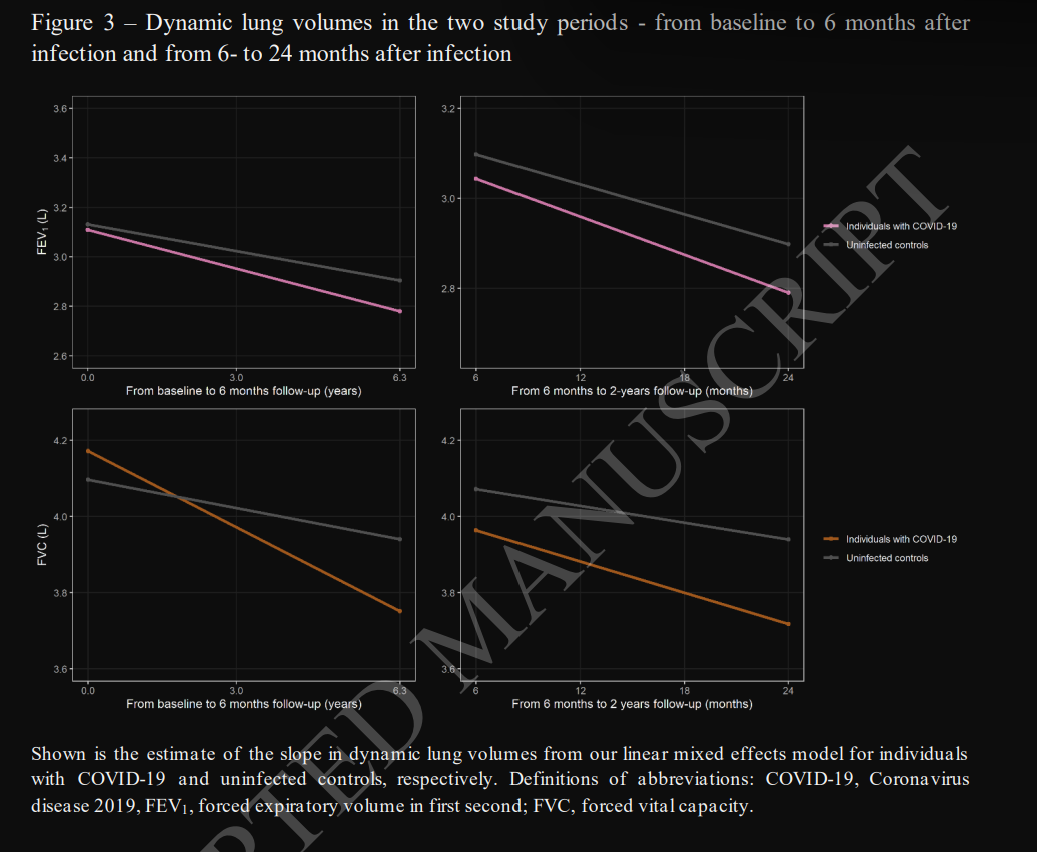
Results: 52 individuals (48.6%) attended the two-year examination at median 1.9 years (IQR 1.8;2.4) after COVID-19, all with mild infection. Individuals with COVID-19 had an adjusted excess decline in FEV1 of 13.0 mL per year (CI 23.5;2.5),p=0.02 from prior infection to 6 months after infection compared to uninfected controls. From 6 to 24 months after infection, they had an excess decline of 7.5 mL per year (CI 25.6;9.6), p=0.40. A similar pattern was observed for FVC.
Participants had a mean increase in DLco of 3.33 (SD 7.97) between the 6- and 24- month examination. Conclusion: Our results indicate that mild COVID-19 infection affects lung function at time of infection with limited recovery two years after infection.
FEV1 is a test that measures how much air you can forcefully exhale in one second, decline is used to diagnose breathing obstruction conditions. FVC is used to test the total amount of air a person can forcefully exhale after taking the deepest breath possible, used to diagnose fibrosis (restrictive condition). DLco measures the ability of the lungs to transfer gas to red blood cells.
There are a few caveats that we need to address here, first, each participant had two infections throughout this study, one normal infection, 2 vaccine doses, and a reinfection. The first caveat was one of my primary complaints about the mRNA vaccines before the proverbial fecal storm. They do not give you mucosal immunity, they do jack to really “protect” the lungs, so at the very least they do nothing in the lungs, especially protection.
Another caveat is the small number of people in the study. Third, until very recently Omicron didn’t get to your lungs, so for the most part the effects here are pre-Omicron. We do have another small study on unvaccinated elite athletes (meaning they have better cardiovascular health than probably all of us) where the main aspect of the paper was also mild infection, and with similar findings, but recovery occurred after months.
In the Danish study above there was a measurable loss of lung function after infection that endured even months after infection, even taking into account age-expected decline, there was more decline than expected. The decline is faster in the first 6 months and slows down significantly after that.
They did not observe major improvement, but there was an increase in DLco which I ascribe to a compensatory response, an effect that can be observed in many other forms of long-term sequelae after infection. Obviously, each side of the conversation will push its own biased BS on the public, but alas here we are.
If you followed me on Twitter earlier in the pandemic, it is no secret that I stated the same, mild infection would cause a small level loss of lung function, similar to how Omicron would cause a small loss of cardiovascular function in many people. But here is where we diverge from the orthodoxy.
My damage was measurable, but I recovered, and others who talked to me at the time did too. Since the damage was mostly “scarring” meaning fibrosis, serrapeptase will help you deal with it, and so will…exercising… yeah, that's simple, just exercise, and rucking was what gave me the vastest improvement, I am now better than I was before Covid.
To bring a point home, Covid causes the Thymus atrophy, even Omicron causes it although to a lesser degree. And remarkably the thymus can regenerate itself depending on the degree of damage. Our bodies can recover from almost anything. Sometimes it just need some help =P.
Why am I bringing this up and addressing the questions.
It is really important to understand the long-term consequences of getting infected, and while we have our T-Cells giving us vast and strong protection, the virus isn’t stopped mutating, in fact, a new variant most likely surfaced in Africa…again, if it will dominate like the other Omicron one, time will tell.
It is important to understand because of three variables:
While infection with different Omicron variants have been “correcting” the immune response of the vaccinated, as I linked here, their lungs are more predisposed to damage than the unvaccinated
On the other hand, there are a lot of uninfected, and it is becoming very hard to avoid getting infected. The first infection is often rough, with uncharacteristic after-effects (clotting as a primary example).
The virus has mutated so much and mutates in spots that are so important for immunity, that the unvaccinated are now experiencing annoying diseases and weird after-effects/sequelae
I have many readers, acquaintances, and friends who work in healthcare and each of them messaged me asking about this. Our bodies can recover from the damage the virus induces, especially when you supplement or find your way to mitigate the damage, but this becomes a problem, to each group (unvaccinated, vaccinated, uninfected) when you get Covid, it is “mild”, than a few weeks go by, you get another weird infection (fungal, bacterial), a few weeks go by, another weird respiratory infection, and finally you get nothing else for a few months. Until you get Covid again.
It is important to bring this up because the newest variants while not inducing severe disease, it is getting into the lungs, and guts. A lot is occurring under the hood, so while you don’t get severely sick, different levels of damage are being done uniquely to each individual. Omicron’s immune response in vaccinated and unvaccinated is a dual-edged sword, great to give you immunity, but kinda horrible for everything else if it is systemic.
I know many people in good health, with a decent income, no chronic diseases, and good diets who are experiencing, at least partially, everything I have written about in recent months, it was the main reason for this section of this article. Hopefully, clarify a little bit without a lot of science talk. For people who never got infected, pay a lot of attention after your first infection, because for what is worth, the first infection in your life tends to produce clots after the infection, rarely during, especially in pre-disposed people (like me).
Keep taking care of your health, a healthy diet within your means, exercise, and whatever other methods you see fit, be it supplementation with different natural products, amino acids, vitamins, but at the very least Vitamin D, and some occasional zinc and magnesium.
Now I will focus on the next piece, about Cyclophilin, RAGE, and connecting many dots, I don’t expect it to take long, but I will take the time needed. I may publish a random Q&A on Sunday because I never did one.
If you supported this work at any time, or support it, thank you very much.

I need to reply to e-mails and messages, be patient. A lot of work and other things pilled up while sick. Otherwise I hope everyone is good and wish you a good rest of the week.
This has happened to my daughter. Neither of us is vaccinated. She caught COVID in the fall of 2020. She never had to go to the hospital, but was fairly sick. Now in 2024 her lungs have still not recovered, and she still has a cough whenever her immune system is challenged. Never had any lung problems prior. Not a smoker or anything. I was around her when she was sick, but I never got COVID and still haven't.