
Australia announced its first human case of Bird Flu
Some avian business

You plan for one thing, execute another and fate pushes you into something else. This one be long, or overly complicated, but hopefully, you will understand why I told you, the reader, twice now to consider stocking Olive Leaf Extract. First things first, per the title. Also, this will not be science heavy, see it more as an…essay, weirdly structured.
Australia announced its first human case of Bird Flu.
Australia reported its first human case of avian influenza on Wednesday in a child who authorities said had been infected in India but made a full recovery, while a different highly contagious strain was found on an egg farm.
The H5N1 strain of avian flu has swept the globe in recent years, killing billions of farmed and wild birds and spreading to tens of mammal species.
Health authorities in Australia's southeastern state of Victoria said contact tracing had not identified any further cases and there was a very low chance of others becoming infected as the flu does not easily spread between people.
"This is the first confirmed human case of highly pathogenic avian influenza in Australia," Dr Claire Looker, the state's chief health officer, said in a statement.
It was the first instance of detection of the H5N1 strain in a person or animal in the country, she added.
"The child experienced a severe infection but is no longer unwell and has made a full recovery."
The case in Victoria involves an H5N1 virus, but the strain is not the same as those responsible for outbreaks in the United States, Looker said.
I have a very bright dairy farmer who sometimes sends me messages, and the rumor in the dairy industry is the following. H5N1 has been circulating in both dairy cows and humans for a while, over a year now, but nobody bothered to test it, and disputes between government orgs have been going on for months.
If you are not testing, you may ascribe severe respiratory infection to any other amalgamation of pathogens. Why avian flu in cows is a problem ?
Simply put, the cow udders (tits) are one of the few places in the animal that share a specific receptor with birds and humans. Sialic Acid receptor α2,3 and SA-α2,6. This is me, talking exactly how avian flu used this receptor 2 years ago and this would be the receptor that would enable species to jump.

Sialic acids are among the most complex parts of biology (and glycology) there is because these are sugar molecules that can “stick” together and change how the cells and receptors respond. Imagine these are custom-made Lego pieces that enable you to build incredibly complex Legos (cellularly speaking).
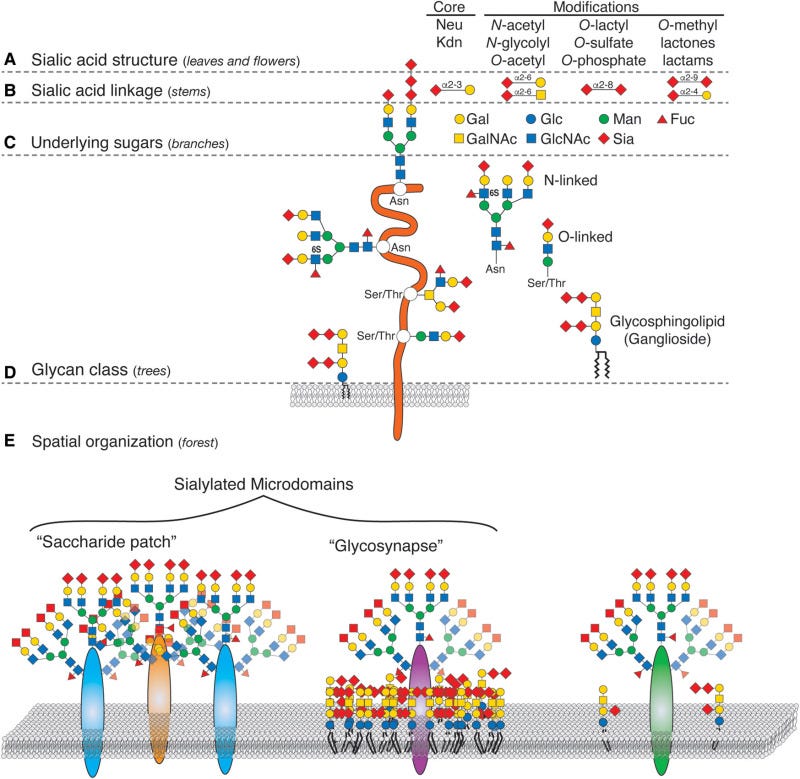
Even my so-feared H10N3 uses the same receptor “We identified multiple amino acid residues related to adaptation in mammalian hosts in these novel H10N3 viruses (appendix pp 6–7, 27–32), and both human-derived and chicken-derived isolates showed high affinity for sialic acid-α-2,6-galactose receptors”. Feared because unlike H5N1, any of the current clades, it doesn’t kill avians, it only causes severe disease in mammals, especially humans.
This is one of the main reasons for a portion of biologists, veterinarians, and governments (too little, too late) fear the widespread and persistent transmission of Avian Flu in cows. If reservoirs form, especially in the cow’s udders, it will further adapt to exploring mammal receptors, and jump to humans.
The good news is many animals and people probably have direct or indirect exposure to H5N1. Hunting dogs with exposure to the virus have protective antibodies, the consumption of PASTEURIZED milk could theoretically give millions of these protective antibodies too, plus many immunological cross-reactions between other HxNx strains and H5N1 apply.
My “job” (including the research I do by the support I receive here) is often of a forecasting nature. Analyzing a large amount of data, often without apparent connection, so I can properly assess future outcomes. So let us assume, either by nature’s will, fate, or any other reason H5N1 consistently spreads among humans. Why am I worried ?
First, since this is fresh on your mind. HMGB1. Does it play a role in H5N1 ?
Summing up, these data suggest that HMGB1 contributes to the pathogenesis of IAV (H5N1) infection in mice by inducing extensive inflammatory responses and severe pneumonia. Paper for the bullet points here.
The released HMGB1 and proinflammatory cytokines form A feed-back loop to enhance the inflammatory response due to virus infection.
The inhibition of HMGB1 release or neutralization of extracellular HMGB1 would suppress inflammatory response and disease severity.
Post-translational modifications (PTMs), such as acetylation, are critical for the release of HMGB1 following virus infection.
ROS is potentially involved in the regulation of inflammatory response via interaction with HMGB1.
Intracellular HMGB1 regulates viral replication by interacting with viral genomes, viral proteins, or even cellular proteins.
There is one specific animal that is a very good forecasting surrogate for avian flu effects in humans, but since we don’t share many biological similarities, it is often ignored as a potential tool to “predict” pathogenic behavior. Cats. Why cats ? Because cats can get infected with Coronaviruses (Feline-CoV being the most common).
Since the tropism (which “road” and which organs a virus/pathogen prefers) of the current avian flu is somewhat uncharacteristic, it is the one I was most eager to read about.
Highly pathogenic avian influenza virus (HPAIV) H5N1 can infect mammals via the intestine; this is unusual since influenza viruses typically infect mammals via the respiratory tract. The dissemination of HPAIV H5N1 following intestinal entry and associated pathogenesis are largely unknown. To assess the route of spread of HPAIV H5N1 to other organs and to determine its associated pathogenesis, we inoculated infected chicken liver homogenate directly into the intestine of cats by use of enteric-coated capsules. Intestinal inoculation of HPAIV H5N1 resulted in fatal systemic disease. The spread of HPAIV H5N1 from the lumen of the intestine to other organs took place via the blood and lymphatic vascular systems but not via neuronal transmission. Remarkably, the systemic spread of the virus via the vascular system was associated with massive infection of endothelial and lymphendothelial cells, resulting in widespread hemorrhages. This is unique for influenza in mammals and resembles the pathogenesis of HPAIV infection in terrestrial poultry. It contrasts with the pathogenesis of systemic disease from the same virus following entry via the respiratory tract, where lesions are characterized mainly by necrosis and inflammation and are associated with the presence of influenza virus antigen in parenchymal, not endothelial cells. The marked endotheliotropism of the virus following intestinal inoculation indicates that the pathogenesis of systemic influenza virus infection in mammals may differ according to the portal of entry.
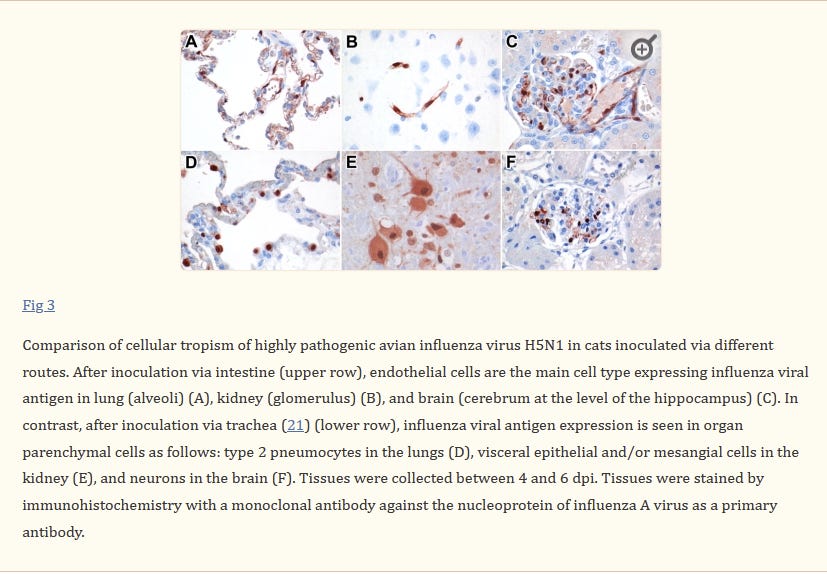
It is a shame we have no further information on the cats here, especially if they had a history of FCoV infection. This research has some caveats too.
The uncharacteristic endothelial and lymphendothelial spread of the virus, leads to systemic spreads, systemic disease, and multi-organ damage
This spread only occurred when the virus was injected into the “gut” of the cats
Depending on how the virus enters the body, the course of the disease changes
So far, systemic, fatal disease is often seen in poultry, not mammals
I still stand by all my assertions up to this point, I do not think this should be something to extensively worry about, or worse develop a sort of neuroticism, but understanding how the disease acts is necessary to be able to mitigate or prevent damage. It is especially worrying to me the endothelial tropism, since from any honest perspective, we have hundreds of millions of people with a somewhat compromised, but functional endothelial system.
My major worry is a complete species jump, a sustained human-to-human transmission of Avian Flu, and Omicron. Omicron opens up people to stealth, silent cycle of disease, perfect for opportunistic infections, and this can kick things up a notch, or two. Well, Former CDC Director Dr. Robert Redfield has a few words to share too.
Of course, this opens the perfect opportunity, mimicking 2020 for “behavioral units” to start their nudging efforts and unconstitutionally execute psychological operations in their countries.
A Randomized Trial of Behavioral Nudges Delivered Through Text Messages to Increase Influenza Vaccination Among Patients With an Upcoming Primary Care Visit
Conclusions
Text messages encouraging vaccination and delivered prior to an upcoming appointment significantly increased influenza vaccination rates and could be a scalable approach to increase vaccination more broadly.
The “new normal” is psychological and cognitive operations executed daily, at scale, by bots, messages, videos, and text. Talk to you all soon =).
I am grateful for your support !

Going to try and finish my short story and publish it in the next couple daysm hopefully people like it. AI doomers clearly won't 🤣
Just in time for the 2024 US elections. Been wondering when this bad boy was going to show up. At least I have plenty of toilet paper this time.